SOURCE AUDIT · SEPTEMBER 2026
Sources and reproduction
The presentation combines the published hardware study, supplied recordings and checkpoints, local CAD, and a separately documented Isaac Lab workbench. This page records their different scopes and the transformations used to make the figures.
Published evaluation
The results CSV is a manual transcription of the per-chicken rows of Table 4 in Davar et al., Advanced Robotics Research (2026). A script checks the row sums and computes the displayed totals. It does not infer outcomes from video names or jaw commands.
| Subset | DP successes / trials | Interpretation |
|---|---|---|
| Seen | 84 / 100 | Ten birds used in demonstration collection; nominal evaluation |
| Unseen | 29 / 40 | Four held-out birds; 12 nominal and 28 disturbed trials |
| All | 113 / 140 | Grasp, lift, and scripted rehang |
Source discrepancy: the unseen per-bird disturbed successes are 4, 3, 6, and 5, which sum to 18/28. The printed total says 17/28. The unseen nominal rows sum to 11/12; 11 + 18 = 29, matching the paper’s overall unseen result. The presentation retains the consistent headline and seen/unseen totals, and does not silently treat the conflicting subtotal as resolved. A trial-level outcome sheet would be needed to adjudicate it.
The original edited video contains an older results table. The new presentation uses the 2026 publication, with its date and source stated explicitly.
Per-chicken CSV · Summary CSV · Figure PDF
Supplied archive coverage
| Method | Replay episodes | State/action rows | Video episodes | Camera files |
|---|---|---|---|---|
| DP | 142 | 56,305 | 142 | 426 |
| IBC | 101 | 15,388 | 3 | 9 |
| LSTM-GMM | 3 | 1,283 | 3 | 9 |
The archive contains 444 camera files across 148 episode folders. These counts are inventory counts, not the paper’s outcome denominators. The replay buffers contain robot state, jaw state, actions, timestamps, and episode boundaries; RGB streams are separate MP4 files.
The supplied training/ folder contains checkpoint ZIPs and their logs. A complete 100-demonstration training dataset and a trial-to-paper outcome mapping were not identified in this snapshot. The paper is the source for the demonstration count. Full checkpoint ZIPs and raw recordings remain in the external archive; the repository includes only small selected exports.
Machine-readable inventory, archive sizes, and replay-buffer hashes
Illustrated pipeline overview
The project-page overview uses Amirreza Davar’s supplied pipeline figure. The illustrated layout is preserved. Four jaw-state numerals were corrected to match GripperController.set_state: 0 = closed and 1 = open. The labels on the gripper arrows and the equation use the same convention. The webpage uses an SVG exported from the corrected PDF; the camera photographs retain their source resolution.
Corrected PDF · Original supplied PDF
Actual offline denoising replay
presentation/replay_denoising.py loads the supplied outputs/blah/checkpoints/latest.ckpt from checkpoint_dp.zip, selects the EMA weights, and runs the original policy class. Model weights load strictly, without missing or extra keys.
- Recorded evaluation episode: 14; observations at elapsed 5.0, 12.0, and 20.0 seconds.
- Two observations per input, three RGB cameras, end-effector pose, and both jaw states.
- Random seed 42; 100 DDIM denoising iterations; horizon 16; trained action prefix length 6.
- The scheduler records initial Gaussian noise and every
prev_sample, yielding 101 arrays per observation. Values are exported both normalized and decoded into action units. - The three orientation dimensions are retained in the downloadable trace. The figures emphasize XYZ and the two jaw channels.
Interpretation: these are real model outputs from a new offline replay. They are not the original deployment predictions, and they were never sent to the robot. The source MP4s do not expose original camera wall-clock timestamps, so their elapsed time is matched approximately to each episode’s state timestamps. This is suitable for explaining the model, but is not an exact reconstruction of original inference conditions or a new success evaluation.
The final predicted sequence contains 16 positions in a temporal window. With two observation steps, the trained six-action prefix is indices 2–7 in one-based display indexing. The public runtime script overrides this setting; the offline replay preserves the checkpoint’s trained prefix length.
The interactive plot keeps normalized XYZ at a fixed scale unless “Zoom to plan” is selected. The revised static figure uses fixed axis limits; a separate final-action figure shows the physical units. All intermediate jaw values are retained in the data. The revised process video displays their full observed range.
Checkpoint hash and exact configuration · Full numerical trace · Browser-readable JSON
Camera-overlay process video
The 10.93-second process video uses the supplied recording from episode 14, camera 2. At observations 5, 12, and 20 seconds, the footage pauses while six independently initialized candidates are denoised. The replay uses the public evaluation script’s overrides: 16 DDIM iterations and 15 returned future actions from a 16-step window. Every captured iteration is displayed for at least two frames. Color indicates future action index; the jaw inset displays raw values for candidate 1. Moving footage resumes at 4× speed.
These are actual new offline samples, not the original executed plans. The image overlay uses a local affine displacement estimate fitted from rigid gripper features and logged end-effector translation. The manually selected image anchor approximates the midpoint between the jaws. It is not a calibrated TCP location. No measured camera intrinsics or robot-to-camera transform were found.
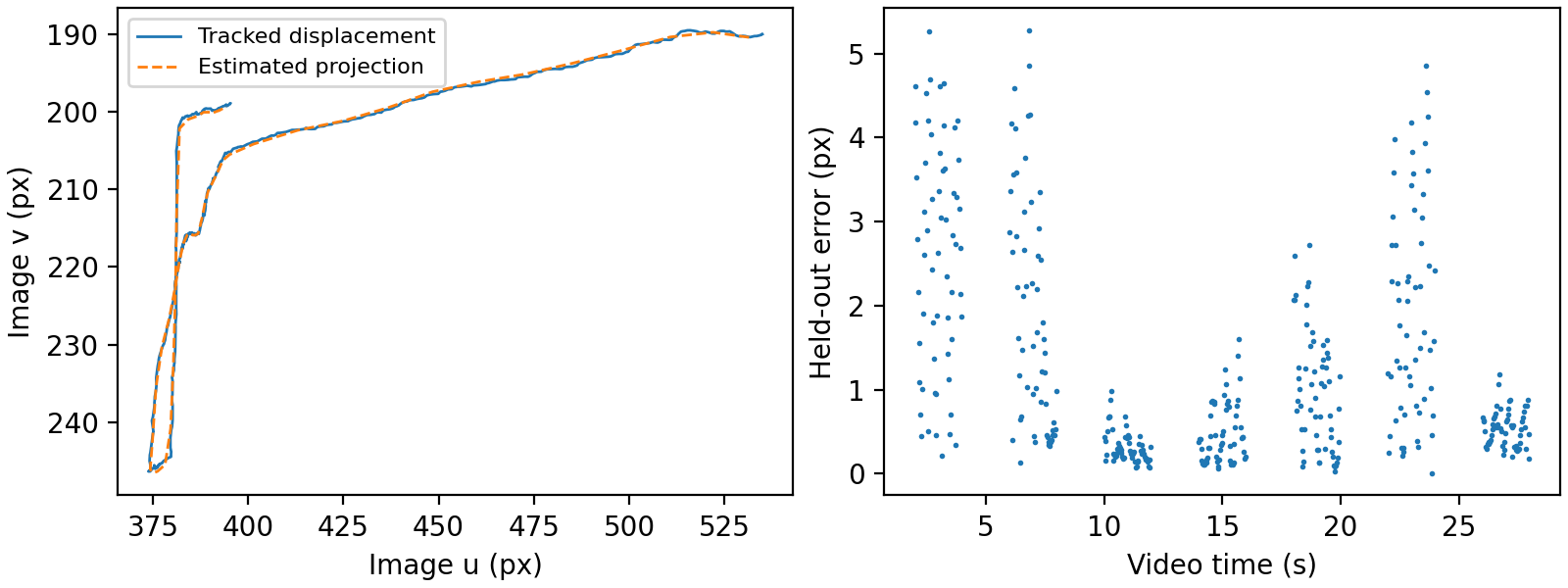
The estimate was fit on alternating two-second blocks and evaluated on the withheld blocks: 1.76 px RMS, 4.11 px 95th-percentile tracking error. The fitted video-to-state offset is −0.28 s. These errors validate tracked local displacement only; they do not establish absolute projection accuracy. Noisy intermediate coordinates can extend beyond the fitted motion volume, so their projection is an extrapolation. The checkpoint inputs still use approximate elapsed-time alignment.
All six candidates and iterations · Checkpoint and replay settings · Projection estimate and limitations · Held-out validation plot · Frame-by-frame edit metadata
Plots and overlays use Matplotlib’s standard style and documented plotting APIs; the trajectory colors use its plasma colormap. The layout is inspired by the official Diffusion Policy project page. These are ChicGrasp visualizations, not outputs of an upstream released video-generation script.
Recorded command timeline
The timeline uses episode 14 of replay_buffer_dp.zarr.zip. Three Cartesian target channels are plotted in millimeters; the two jaw channels use their recorded binary values. Leading all-zero action rows are logger initialization and are excluded from the figure. Right and left closure transitions occur at 20.6 s and 21.1 s. These are commands, not measurements of pressure, contact, or grasp success.
The page’s jaw badges follow recorded commands using elapsed video time. The short film shows the 18–23 s interval at 0.5× speed, with a visible speed label. Full episode clips on the page run at native speed.
Recorded action and state export · Timeline PDF
Archived training curves
For each log, repeated global steps are deduplicated by retaining the last record. The last loss record per epoch is plotted without smoothing. The training workspace normally replaces the terminal batch loss with an epoch mean. Resumed or incomplete epochs are represented by the last available record; the plot does not fabricate missing summaries.
| Run | Unique global steps | Epochs represented | Objective |
|---|---|---|---|
| DP | 167,850 | 0–449 | Noise-prediction mean squared error |
| IBC | 174,150 | 0–449 | Energy-based classification loss |
| LSTM-GMM | 353,349 | 0–469 | Negative log-likelihood |
Objective scales are different; their numerical magnitudes do not rank real-world performance. The LSTM-GMM archive contains resume history and extends beyond the paper’s stated 450 epochs. These plots describe the supplied training artifacts; they do not prove which checkpoint produced every published outcome.
DP CSV · IBC CSV · LSTM-GMM CSV · Figure PDF
Paper, checkpoint, and runtime differences
| Item | Published account | Supplied implementation/artifact |
|---|---|---|
| Action representation | Five task commands: XYZ + two jaws | Eight-value stored tensor, including three orientation values |
| Observations | Descriptions include dual-view observations and joint proprioception, while collection uses three cameras | Checkpoint: three RGB views, six-value end-effector pose, left/right jaw state |
| DP timing | 100 DDIM steps; Table 2 says 12 output actions, Table 3 gives trained nact = 6 | Checkpoint: 100 steps, horizon 16, nobs = 2, nact = 6. Public eval script sets 16 denoising steps and nact = 15, with default loop increment 6 |
| Jaw flags | Method definition uses 1 = open, but the runtime prose describes a stable grasp with both flags = 1 | GripperController sends open requests for 1 and close requests for 0; the figures follow the code |
| Cameras | D435 in the paper | D415 in the previous README; model and drawing do not establish hardware identity |
| LSTM-GMM epochs | 450 | Supplied log spans 470 epochs with resume history |
These discrepancies are documented rather than silently changing the archived controller. No hardware command was executed during this presentation work.
CAD, film, and simulation
The CAD renderer reads visible meshes from the local gripper_customized_1.usd assembly with instance proxies and composed transforms. It exports 15,180 triangles. Color accents identify the local left/right finger groups; the camera orbits the intact assembly without animating joint motion. The local assembly omits the camera holder. Mesh and source provenance.
The project overview remains a placeholder until its 80-second edit is finalized. Previous edits are preserved in the local archive. The simulation excerpt shows a held practice configuration; it is separate from the published hardware evaluation.
All-episode evaluation grid
The grid includes every supplied diffusion-policy recording: episode IDs 000 through 141, wrist camera 0, in row-major order. This is an archive count, not the paper’s 140-trial denominator. The 12 × 12 grid has two legend tiles. All recordings begin together at uniform 4× speed and hold their final frame through the common ending. No success or failure status is inferred from jaw commands.
These MP4s end before the lift and scripted rehang. The paper’s full-task results are reported separately. Episode IDs, source durations, camera paths, and SHA-256 hashes.
The IBC and LSTM-GMM sections each include all three available wrist-camera recordings (episodes 000–002). Each method has its own synchronized three-window grid and individual episode browser. Playback is 4× with held final frames. These video subsets do not represent all 140 trials reported per method in the paper. IBC manifest · LSTM-GMM manifest.
Individual action videos
Twenty diffusion-policy examples were selected by visible two-leg capture using wrist and side views. The unsuccessful example is DP episode 18. These are grasp-phase observations, not independently verified full-task outcome labels. The 23 videos preserve their original recorded endings.
The action overlays replay each method’s own checkpoint offline: DP uses six independent candidates and all 16 DDIM steps; IBC uses five rounds of 4,096 candidates, with 128 displayed per round; LSTM-GMM replays recurrent history and displays one-step samples, mixture means, and its selected action. IBC and LSTM-GMM displays are not denoising trajectories.
Per-episode image projections estimate local displacement from tracked gripper features, with a tracked origin at each observation. There is no measured camera calibration. Uncorrected held-out affine RMS errors range from 0.4 to 6.2 pixels; episode 57 has the largest error. These errors measure displacement fit, not absolute TCP accuracy. Displayed plans were not executed; playback resumes the original recording.
Reproduce and extend
Use the scripts in presentation/README.md. The exports preserve source filenames, checkpoint configuration, archive coverage, and hashes. The public repository base inspected was commit 321a566.
python presentation/analyze_sources.py --data-root /path/to/ChicGrasp-data
python presentation/build_figures.py
python -m http.server 8000 --directory docs
Offline GPU replay and CAD export require their respective model and OpenUSD environments. Viewing the page only requires a browser; the numerical explorer loads a local JavaScript data bundle and does not call a model service.
Original method inspiration: Diffusion Policy project page. All shown hardware, recorded observations, result counts, and model traces are ChicGrasp material.